.png)
What Comic Con and a Folk Festival Have in Common (And What They Don't)
Updated: Jun 30
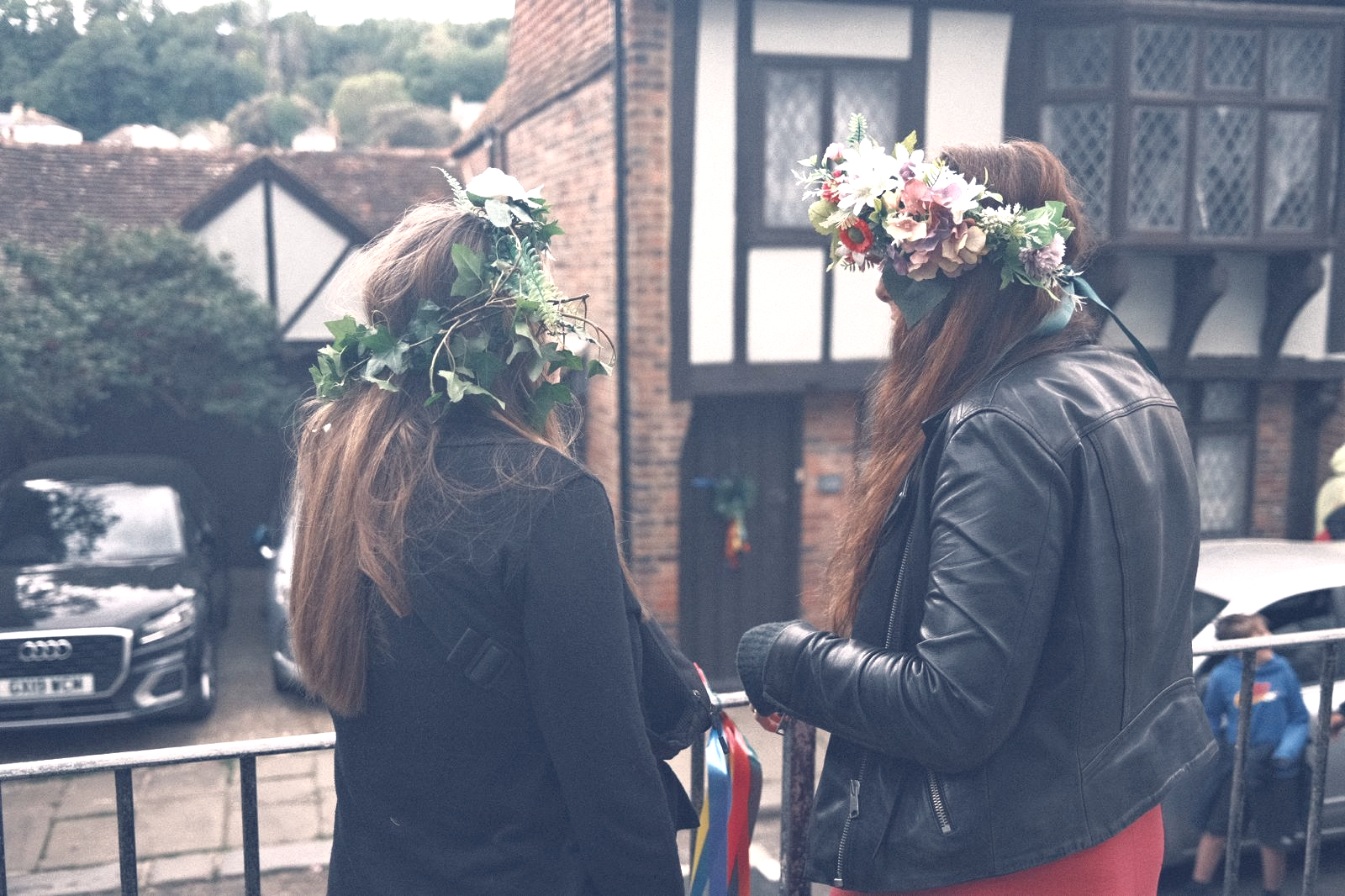
Someone said it to us recently, in the comments, with the air of a person making a point they consider unanswerable: attending a folk festival is basically cosplay. Going to the Hastings Jack in the Green is basically going to Comic Con. You dress up. You gather with enthusiasts. You perform an identity that is not your daily one. What, precisely, is the difference?
It is a good question. It deserves a serious answer, which means starting with the parts they are right about.
The similarities
Costume as participation
Both Comic Con and a folk festival involve dressing as something other than yourself as a form of active engagement rather than passive spectatorship. This is not trivial. Putting on a costume is a commitment — it changes how you move through a space and how other people relate to you. In both contexts, it signals membership, knowledge, and investment.
Community of enthusiasts
Both create temporary communities of people who share an esoteric interest that most of the world does not understand or care about. The person in a meticulously accurate Mandalorian suit and the person in a border morris kit with bells and face paint are both difficult to explain at the bus stop. The solidarity of the inexplicable is real in both directions.
Transmission of tradition
Comic Con has its own customs, hierarchies, in-jokes, and accumulated knowledge, passed between participants, changed over time, policed by insiders and opened to newcomers. In structural terms, this resembles folk tradition. Both are transmitted person to person, both evolve, and both have arguments about authenticity.
Seasonal ritual
Both are calendar events that people plan their year around, travel for, and experience as significant. The emotional register — anticipation, immersion, aftermath — is genuinely similar.
So yes. The comparison holds, up to a point. Here is where the point runs out.

The difference that matters
Every intellectual property at Comic Con is owned. Disney owns the Mandalorian. Warner Bros owns Batman. The enthusiasm of every person in that building is genuine; the object of their enthusiasm belongs to a corporation that profits from it, controls it, and can change it at any point. When Disney decided that Han Solo did not shoot first, every fan who had built a relationship with a character who shot first had that relationship altered without their consent. The story was never theirs. It was licensed to them, temporarily, at the corporation's discretion.
Folk traditions belong — in the meaningful sense — to no one, or to everyone, which amounts to the same thing. Nobody owns the Pharisees. Nobody owns the Jack in the Green. Nobody can trademark the knucker. The communities that carry these traditions can change them, argue about them, add to them, and occasionally let them die — and if they let them die, that is the community's loss and the community's choice. There is no rights-holder to override the decision.
What this means for creativity
At Comic Con, creativity operates within the limits set by the IP. Fan art, cosplay, and fan fiction are tolerated or encouraged, but they exist in relation to a canonical text that the corporation controls. The creativity is real; it is also bounded. Nobody at a Marvel panel is going to suggest that Tony Stark should be fundamentally different, because Tony Stark is not available for fundamental transformation.
Folk tradition has no canonical text. The Hastings Jack in the Green revival has been running for forty-two years and has changed throughout. New elements have been added; old elements have been debated; the community has argued, as communities do, about what is essential and what is decoration. Those arguments are not a dysfunction of the tradition. They are the tradition. They are the community doing what folk communities have always done: making culture collectively, in real time, in response to the specific people and place and moment involved.

Who profits
Comic Con is a ticketed event. Merchandise is licensed. The enthusiasm of the attendees generates revenue that flows, predominantly, to corporations. This is not a moral failing — large events cost money to run — but it is a structural reality. The economic relationship between a fan and their fandom runs predominantly in one direction.
Folk festivals are frequently free or low-cost, organised by volunteers, and economically embedded in their local area. The money spent at the Hastings Jack in the Green goes to Hastings — to pubs, to local food vendors, to the town's economy. The value the community generates circulates within the community.
What cannot be moved
A Comic Con could be held anywhere. The IP is not specific to a location. San Diego Comic-Con could, in principle, relocate to Phoenix without changing its fundamental nature. The stories, the characters, the franchises do not belong to San Diego. They belong to studios.
The Hastings Jack in the Green cannot be relocated without ceasing to be what it is, because what it is includes Hastings — the specific streets, the specific coastline, the specific community whose history is embedded in the festival's forty-two-year memory. The tradition grew there, in response to that place and those people. Move it and you have something else: something that would have to build its own meaning from scratch.
The most interesting difference
Corporate IP is, in principle, immortal. Disney will defend its ownership of Mickey Mouse for as long as it is economically viable to do so. The stories will continue because there is money in their continuation.
Folk traditions can die. They persist because people freely choose, year after year, to carry them — without legal compulsion, without financial incentive, without a corporation maintaining them as assets. That precarity is also their dignity. A tradition that continues because a community chooses to keep it going, even when they could simply stop, means something different from a franchise that continues because its quarterly returns depend on it.
The comparison is illuminating, and the person who made it was not wrong. Dressing as Mr Dobbs and dressing as Spider-Man are both costumes, both community, both enthusiasm. But one of those things you own — collectively, imperfectly, with arguments and compromises and the occasional heated committee meeting — and the other owns you. Not maliciously. Just structurally.
The difference is whether you are a participant or a customer.
At its best, folk culture makes participants. It always has. That is, in the end, what we are trying to preserve.
Want to read more? Learn about What We Lose When Folklore Goes Global.

Sussex Roots
Sussex Roots began as an experiment by people who were not sure anyone would come with them. The second edition exists because you did. We have learnt an enormous amount — from the research, from the folklore community, from the readers who knew things we didn't and told us so — and we are braver for it.
There will probably be more editions. There will definitely be more investigations. The folklore of Sussex and Kent is not close to running out of surprises, and neither, it turns out, are we.
Sussex Roots, second edition, is available here (UK) and here (US).

The Untruth Seekers are dedicated investigators of the legends, ghost stories, and historical mysteries lurking beneath the surface of Sussex and beyond. Their confidential files document the folklore, hauntings, and half-buried histories that most people walk past without a second glance. All findings are published under the series From the Confidential Files of the Untruth Seekers, for readers who suspect there is always more to the story.


Comments