.png)
Dragons of the British Isles: From the Welsh Ddraig Goch to the Sussex Knucker
Updated: Jun 30
The British Isles have always had dragons. Not the uniform, fire-breathing, castle-circling variety of continental imagination, but something considerably more varied – and, in their way, considerably more interesting.
What emerges from a survey of British and Irish dragon folklore is less a single beast and more a whole taxonomy: a geography of wyrms shaped by the landscapes that produced them, the communities that feared them, and the very particular ways those communities decided, in the end, to deal with them. Heroic knights feature surprisingly rarely. Poisoned pies feature more than once.

Wales: the winged and the legless
Wales is where the dragons are most conspicuous, having had the good fortune to place one on their national flag. The Ddraig Goch – the Red Dragon – is winged, fire-breathing, and unmistakably regal. It features in the Mabinogion, battles invading white dragons, and has been interpreted as everything from a symbol of Celtic resistance to a straightforward emblem of national pride. The Welsh brandish it on banners and celebrate it with proper national fervour.

Wales also offers the Gwiber – a legless, winged serpent considerably less celebrated than its red counterpart but no less tenacious in the folklore record. The Gwiber tends to haunt specific locations, to be associated with particular acts of local malevolence, and to meet its end through ingenuity rather than knightly virtue. The Welsh dragon tradition, in other words, accommodates both the magnificent and the frankly peculiar.
Sussex: the knucker and the forest serpent

Sussex, that peculiar repository of draconic lore, names its water-dwelling terrors Knuckers – from the Saxon nicor, meaning water dragon. These limbless beasts inhabit the bottomless knuckerholes scattered across West Sussex: natural springs where the chalk aquifer meets the surface and the water, disconcertingly, never freezes and never fully drains. The knuckerholes at Lyminster and Lancing are the most frequently cited, and they do have a genuinely unsettling quality – cold, still, and apparently without bottom.
Knuckers emerge at night to snatch livestock and terrorise villages. What distinguishes the Sussex approach from the broader tradition is the notable absence of knights. The Lyminster knucker was famously dispatched not by an armoured hero but by a local lad armed with poisoned pies – a solution that speaks well of Sussex pragmatism, if less well of the knucker’s discernment.

The dragon of St Leonard’s Forest, near Horsham, offers a different variation: a nine-foot poisonous serpent, black of body and red of belly, documented in a pamphlet from 1614 that describes it breathing flames but, unusually, preferring rabbits to men. Sussex’s dragons, it seems, are not above having preferences.
Northern England: the worms of Durham and Northumberland

Venture north to Durham and one encounters the Lambton Worm – a serpentine horror possessing the disconcerting ability to rejoin severed portions of its body. Cutting it in half, as various characters discover to their cost, simply produces two functioning worms. The eventual solution involves a suit of armour studded with spear blades, which at least has the virtue of commitment.
The Sockburn Worm haunted the same county, whilst Northumberland offers the Laidly Worm, a cursed princess transformed into a dragon by her stepmother’s malevolent enchantment: a creature who is simultaneously monster and victim, which gives the story a rather different quality than the straightforward pest-removal narratives elsewhere.

Yorkshire, not to be outdone, presents the Dragon of Wantley – a satirical beast of gluttonous disposition, whose legend was sufficiently well known to be adapted into a comic opera in the eighteenth century.
The north of England, it appears, could produce dragons for multiple purposes: horror, tragedy, and social commentary alike.
Scotland: the venomous and the vast
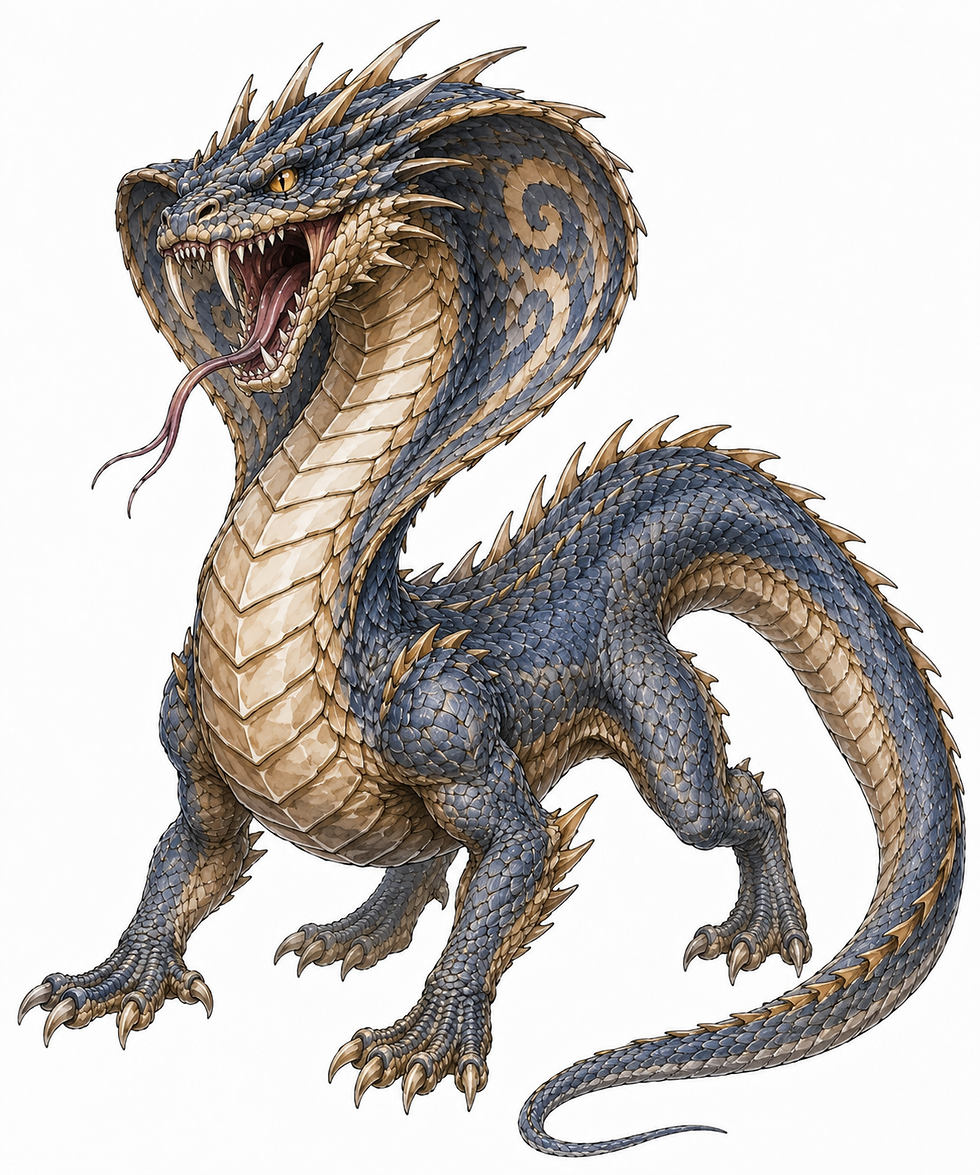
Scotland’s dragons eschew wings and fire-breathing entirely. The Beithir dwells in mountain caves and sea lochs, armed with a venomous sting rather than flame – a creature better suited to the Highland landscape than any fire-breathing variety would be, given the climate.

The Orkney Islands claim the Mester Stoor Worm, a creature of such prodigious size that its death throes created Iceland’s volcanoes and the Shetland Islands from its teeth. Scotland, it turns out, produces dragons on a geological scale.
Ireland: the great worms and the missionary hazard
Ireland’s dragons – the Ollphéisteanna, or great worms – similarly lack wings and rarely breathe fire. The most formidable was Caóránach, mother of all Irish demons, defeated depending upon one’s source by either Fionn Mac Cumhaill or Saint Patrick himself, a discrepancy that perhaps says something about the reliability of sources for events of this nature.

The Oilliphéist of the Shannon cut the river’s course whilst fleeing Patrick’s missionary zeal, pausing only to swallow – and subsequently regurgitate – a drunken piper whose music gave the beast indigestion. It is, by some margin, the most specific detail in any of these accounts, and raises questions about the piper that the legend declines to answer.
A geography of wyrms
What emerges from all of this is a coherent, if unplanned, taxonomy. Winged and fiery in Wales. Water-dwelling in Sussex. Serpentine and regenerating in Durham. Venomous and wingless in Scotland. Massive sea-serpents in Ireland. Each region’s dragon reflects its landscape – the knuckerholes of Sussex’s chalk, the lochs of Scotland, the Shannon of Ireland – and each region’s solution to the dragon problem reflects something about the people who told the story.
The British and Irish dragon tradition is, in the end, less about monsters than about the places that produced them. The creatures in these stories belong to specific hills, specific rivers, specific springs in specific fields. They are embedded in landscape and community in a way that the generic European dragon, breathing fire at a generic castle, is not. They are local problems, addressed by local means – occasionally by heroes, more often by rather inventive ordinary people with access to a good bakery.

Sussex Roots
The Knucker – Sussex’s own water dragon – features in Sussex Roots, alongside the wider cast of Sussex folklore: the giants, the witches, the fairies, and the other creatures that have inhabited the county’s imagination for centuries.
The knuckerholes are still there, for the record. Cold, still, and reputedly bottomless. The Untruth Seekers have visited. They did not bring pies.

Nobody knows quite how the Untruth Seekers came to accumulate quite so many confidential files. What is known is that they have spent considerable time in the archives, the churchyards, and the slightly odd corners of Sussex, documenting the legends, hauntings, and historical curiosities that the official record tends to overlook.
Their discoveries are published under the series From the Confidential Files of the Untruth Seekers, for those willing to keep an open mind.


Comments