.png)
Jack in the Green, Hastings: History, Folklore, and a Living Tradition
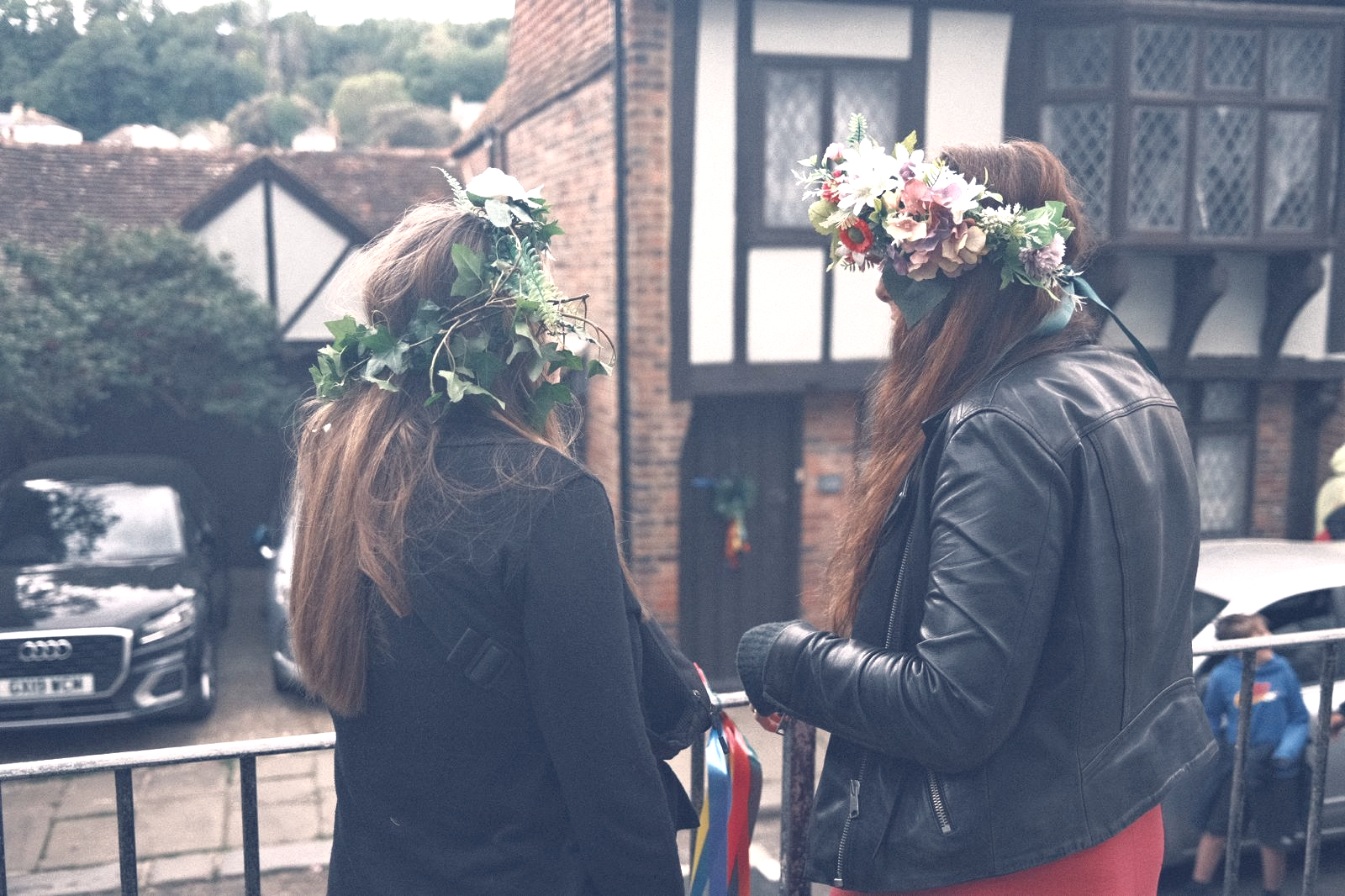
Every May bank holiday weekend, the Old Town of Hastings fills with drums, ribbons, green-painted faces, and an enormous tower of living greenery that moves through the streets with apparent life of its own.

This is the Hastings Jack in the Green: part documented history, part folk tradition, part conscious revival, and part ongoing community creation. It is one of the most distinctive May Day celebrations in England, and it raises questions that are considerably more interesting than they might first appear.
What is Jack in the Green?
Jack in the Green is a figure: a large frame, typically of wicker or wood, covered entirely in branches, leaves, and flowers, and tall enough to conceal the person carrying it inside. The Jack moves through the procession surrounded by attendants – bogies who clear the crowd, the Green Man, and various figures in elaborate costume – and the festival culminates on the Monday with Jack being ritually slain to release the spirit of summer.
At Hastings, the Jack in the Green festival runs across the May bank holiday weekend, drawing visitors from across the country. Morris dancing groups come from throughout Britain and beyond, which is why Morris dancers are such a conspicuous presence – more on that below. The streets of the Old Town, already atmospheric on a quiet day, become something else entirely for three days each May.
What the history actually tells us
Jack in the Green is widely assumed to be ancient – a remnant of pre-Christian May Day ritual, a survival of something older and wilder. The documented history is more complicated, and considerably more recent.
The earliest clear evidence for Jack in the Green dates to the late eighteenth century, and it appears in a specific context: London chimney sweeps. May Day was the sweeps’ traditional holiday. They would parade through the streets in festive dress, carrying the Jack and hoping to collect tips from householders. Contemporary accounts from the 1770s and 1790s describe the figure in recognisable terms: a wicker framework covered in greenery, carried by a sweep concealed inside, accompanied by a small party of attendants.
This is not the origin story most people expect. But it is the documented one. The image of Jack in the Green as an ancient pagan survival was given considerable weight by Victorian and Edwardian writers, most influentially James George Frazer, whose work The Golden Bough interpreted folk customs through a lens of prehistoric ritual and vegetation spirit worship. Frazer’s interpretations have been substantially revised by subsequent folklorists, but his influence on how customs like Jack in the Green are understood has proved remarkably durable.
What we don’t know
The chimney sweep origin establishes when Jack in the Green is first documented. It does not establish when the idea began.
May Day customs involving greenery, garlands, and figures who embody the season are far older and more widespread than the late eighteenth century. Whether Jack in the Green drew on those older traditions, absorbed them, or emerged independently is genuinely unknown – because the people who celebrated these things did not, by and large, write them down. Folk custom lived in communities, in annual repetition, in knowledge passed between neighbours and across generations, long before anyone thought to record it formally.
The absence of documentation is not the same as the absence of practice. What the written record shows is a partial view through a narrow window. What happened outside that window, in the fields and market squares and inn yards of Sussex and beyond, is largely beyond recovery. This is the central frustration of English folk tradition – and, depending on your temperament, a large part of its appeal.

The Hastings revival: why there are so many Morris dancers
The Hastings Jack in the Green in its current form dates to 1983, when it was revived and organised initially as a Morris dancing convention. This is why Morris groups are so central to the event: they were there from the beginning, and the festival grew around and alongside them. What began as a relatively modest gathering has expanded over four decades into one of the most attended folk festivals in the south of England.
The revival is worth dwelling on, because there is a temptation to see a consciously restarted tradition as less authentic than an unbroken one – as though the interruption diminishes it. But the Hastings Jack in the Green has now been running for over forty years. It has accumulated its own history, its own recurring characters, its own stories. People who attended as children now bring their own children. It has become, by any meaningful measure, a living tradition in its own right.
Folklore as a living, democratic tradition
This is perhaps the most important thing to understand about the Hastings Jack in the Green, and about folk tradition more broadly: it does not belong to anyone in particular, and it is not finished.
Every person who makes a costume for the procession, who joins a Morris side, who paints their face green, and who shows up on a May bank holiday morning is participating in an act of cultural creation. Traditions exist because communities choose to enact them – and in enacting them, communities inevitably shape them. New elements enter. Old ones are reinterpreted. Things that were invented last decade begin to feel as though they have always been there.

This is not a corruption of folklore. It is how folklore works. It always has. The Jack in the Green that the chimney sweeps carried through London in 1790 was itself a particular expression of something older and less defined. The version that moves through Hastings Old Town each May is another expression of the same impulse: the desire to mark the season, to gather, to carry something – sometimes literally – that is larger than any individual contribution.
What makes the Hastings festival striking is the range of people it draws in. Established Morris sides with decades of history. First-timers who came on a whim and came back every year after. People in elaborate handmade costumes alongside people in jeans with a sprig of greenery tucked behind one ear. The event makes no great demands of authenticity. It asks only that you show up, which turns out to be a remarkably powerful invitation.
Folklore is democratic in this sense. It grows through participation. It is shaped by whoever turns up, whoever contributes, whoever decides that this particular tradition is worth carrying forward – and in doing so, makes it their own. The Jack in the Green that will process through Hastings next May will be the same tradition it was in 1983, and different from it, and both of those things are true at once.
Sussex Roots

The Jack in the Green is one of the threads that Sussex Roots follows through the wider tangle of Sussex folklore. The book takes the same view the festival itself embodies: that the stories worth telling are the ones that resist easy explanation, that live in the space between history and myth, and that keep shifting in the hands of the people who carry them.
From fearsome giants and cackling witches to ancient beasts and the drumbeat of a modern May Day procession, Sussex Roots traces the unexpected stories that shaped this corner of England – including, right at the heart of it, Jack in the Green.

The Untruth Seekers are a Sussex-based collective with a particular interest in the stories that history forgot to tidy away: ghost sightings, smugglers' legends, cursed treasure, and the kind of local lore that tends to get dismissed at dinner parties. Their findings are carefully documented under the series From the Confidential Files of the Untruth Seekers. They keep meticulous records. They have learned to take nothing at face value.


Comments