.png)
Household Spirits of the British Isles: Brownies, Boggarts, and the Creatures of the Hearth
Updated: Jun 10
Not all the supernatural inhabitants of the British Isles are to be found on lonely moors, in ancient barrows, or lurking beneath the surfaces of lakes.
Some of them are in the kitchen.

The British Isles harbour a peculiar class of domestic spirit – creatures who attach themselves to households, performing nocturnal labour in exchange for cream, porridge, or the simple dignity of non-interference. These are not the capricious fair folk of hill and hollow, but rather industrious, if temperamental, beings of hearth and byre. Their names vary by county and country; their rules, as we shall see, are remarkably consistent.
Scotland: brownies, Gruagach, and the Uruisg
Scotland gives us the Brownie proper – small, brown-haired, ragged creatures who complete unfinished chores whilst the household sleeps. The ideal arrangement, from the Brownie’s perspective, involves cream left by the hearth and no questions asked.

The Gruagach of the Highlands tends specifically to cattle, accepting only cream or honey-sweetened porridge and taking a dim view of any farmer who forgets.
The Ùruisg haunts waterfalls and streams, less inclined to domestic service than its house-dwelling cousins, and is perhaps best left to its own devices.
England: hobs, dobbies, and the danger of ingratitude
England’s variations multiply by region with admirable thoroughness. The North and Midlands claim the Hob or Hobgoblin – dwelling in caves and barns, emerging at night for farm labour and expecting, in return, to be left entirely alone.

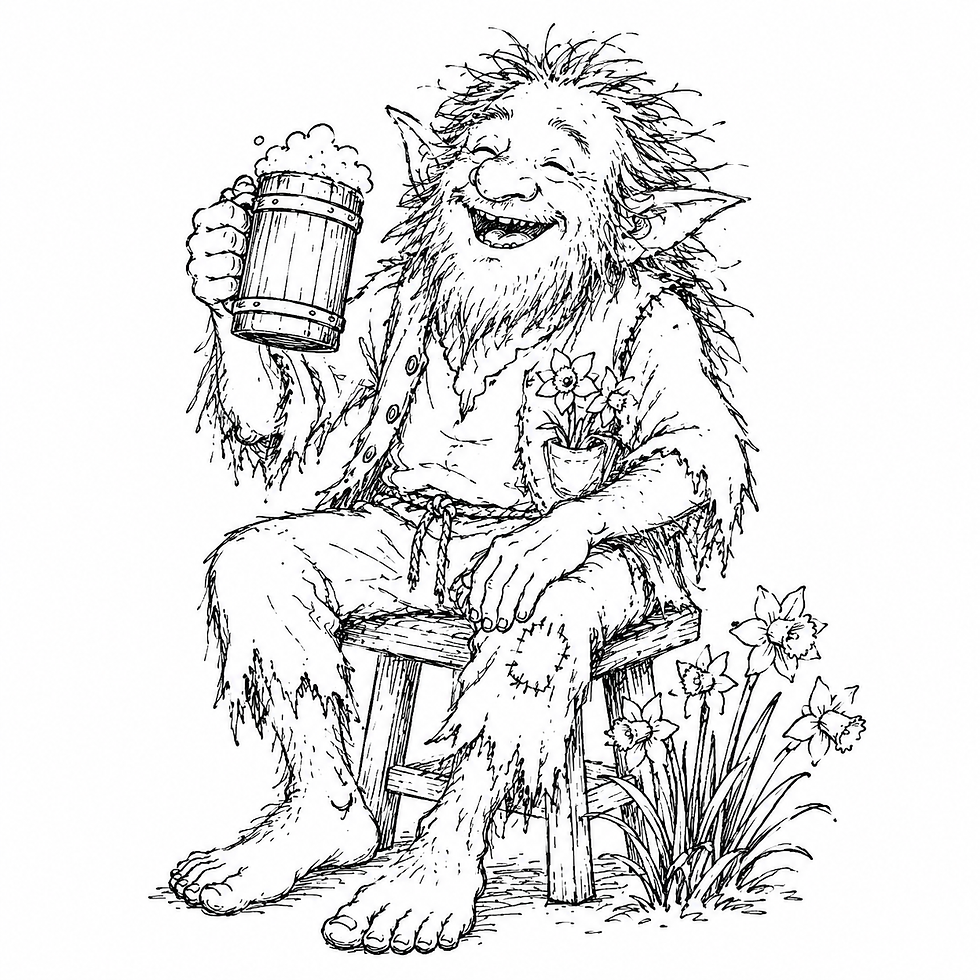
The Lob-Lie-by-the-Fire, or lubber fiend, was a large, hairy creature with a tail, performing housework for milk and fireside warmth.
Yorkshire and Sussex both know the Dobby. When displeased, any of these might transform into a Boggart – a household poltergeist of considerable malevolence, and one significantly harder to appease than whatever benign form preceded it.
Sussex: Mr Dobbs, the Pharisees, and a particular boggart problem
Sussex has a richer tradition of household spirits than its reputation might suggest, and some of its contributions to the wider folklore have proved more influential than the county has received credit for.

Mr Dobbs
The Sussex Dobby goes by the name of Mr Dobbs – a small, helpful household spirit who performed domestic labour at night in exchange for the usual terms: a bowl of cream, no direct acknowledgement, and absolutely no gifts of clothing. That last rule is particularly important and we shall return to it.
Mr Dobbs is often cited as one of the inspirations for a certain literary house-elf of considerable subsequent fame, which, if true, would make Sussex responsible for one of the more recognisable figures in contemporary children’s fiction.
Charlotte Latham’s 1868 survey of West Sussex superstitions – a document of genuine value to anyone interested in the county’s folk traditions as they were actually practised, rather than as later romanticisers imagined them – recorded household spirit beliefs that were then still living parts of rural Sussex life. By 1868, Latham noted, many of these traditions were already in retreat; but the fact that they needed recording suggests they had been vigorous not long before.

The Pharisees
Sussex also has the Pharisees – which is not, despite appearances, a reference to the New Testament. “Pharisees” is a corruption of “Faeries” as it passed through the Sussex dialect, and the term was used in the county for the fairy folk more broadly.
The distinction between household-associated spirits and the wider fairy tradition is blurred in Sussex, as it is elsewhere; beings that began as outdoor creatures tend to drift indoors when the folklore suits them, and vice versa.
Boggarts in Sussex

The Boggart is most commonly associated with the north of England – Lancashire and Yorkshire in particular – but the creature’s reach is wider than its northern reputation suggests. Boggart-type entities, poltergeist spirits attached to specific households or locations, appear in Sussex folklore as elsewhere, and the pattern is consistent: a domestic spirit, once benign or at least neutral, that has been offended and turned malevolent. The specific nature of the offence varies. The consequences do not.
The Sussex boggart tradition is examined in Sussex Roots, where one of the collection’s stories deals directly with what happens when a household spirit’s patience runs out. It is not a fun story. Boggarts, by their nature, rarely are.
Wales: the Bwbach and its strong opinions
Wales offers the Bwbach (plural: Bwbachod) – good-natured goblins who perform chores for maids who leave cream by the fire. The Bwbach is broadly agreeable, with two significant exceptions: it despises religious dissenters and teetotallers with an intensity that goes well beyond the merely personal.
Households containing either could expect the Bwbach’s assistance to be withdrawn, and possibly replaced with something considerably less welcome. What this tells us about Welsh ecclesiastical politics in the centuries when these stories were being told is left as an exercise for the reader.
The Isle of Man and Ireland: the woolly and the well-preserved

The Isle of Man’s Fenodyree is covered head to toe in woolly hair and, true to the regional pattern, performs agricultural labour at night and does not appreciate gifts.
Ireland presents two distinct spirits. The Bean-tighe resembles the Scottish brownie in temperament – quietly helpful, easily offended, disinclined to explain herself.

The Clurichaun is altogether more specialised: a wine-cellar dwelling sprite, perpetually drunk yet impeccably groomed, who guards the household’s wine stores provided he receives regular libations. Anger him and he will empty the cellar whilst singing bawdy songs at midnight. He is, in some respects, the most honest of these spirits about the nature of the arrangement.
The universal rules
Across all these traditions, the terms of engagement are remarkably consistent. Leave cream, bread, or honey – not as payment, which offends their pride, but as acknowledgement. Never offer money. Never gift clothing: this is the one rule that appears without exception from Scotland to Sussex to Ireland, and the one most likely to end the relationship permanently, the spirit apparently considering either its service complete or itself too grand for further labour. Never speak of them directly. Treat them with casual respect, as one might a difficult but indispensable colleague whose name you have been advised not to say aloud.
The hearth as threshold
What united these spirits across the British Isles was the domestic hearth – that liminal space between civilisation and wildness where offerings to household gods had been made since Roman Lares haunted family homes. The Brownie may well be the Christianised remnant of ancestor worship: the helpful ghost of a deceased servant, bound still to the house they once served, accepting cream where once they received more formal devotion.
It is a thought that changes the quality of these stories slightly. The creature performing chores in the dark is not merely a useful convenience or a country superstition. It is, possibly, someone who loved the place and never quite left. The cream left by the fire is not really payment. It is, after a fashion, remembrance.

Sussex Roots
The household spirits of Sussex – Mr Dobbs, the Pharisees, and the boggart who features in one of the collection’s more unsettling stories – are part of the wider world that Sussex Roots explores. The book takes the county’s folklore seriously without taking it literally: the same approach these traditions have always deserved and rarely received. Whether you leave cream by the hearth is, of course, entirely your own business.

The Untruth Seekers are dedicated investigators of the legends, ghost stories, and historical mysteries lurking beneath the surface of Sussex and beyond. Their confidential files document the folklore, hauntings, and half-buried histories that most people walk past without a second glance. All findings are published under the series From the Confidential Files of the Untruth Seekers, for readers who suspect there is always more to the story.


Comments